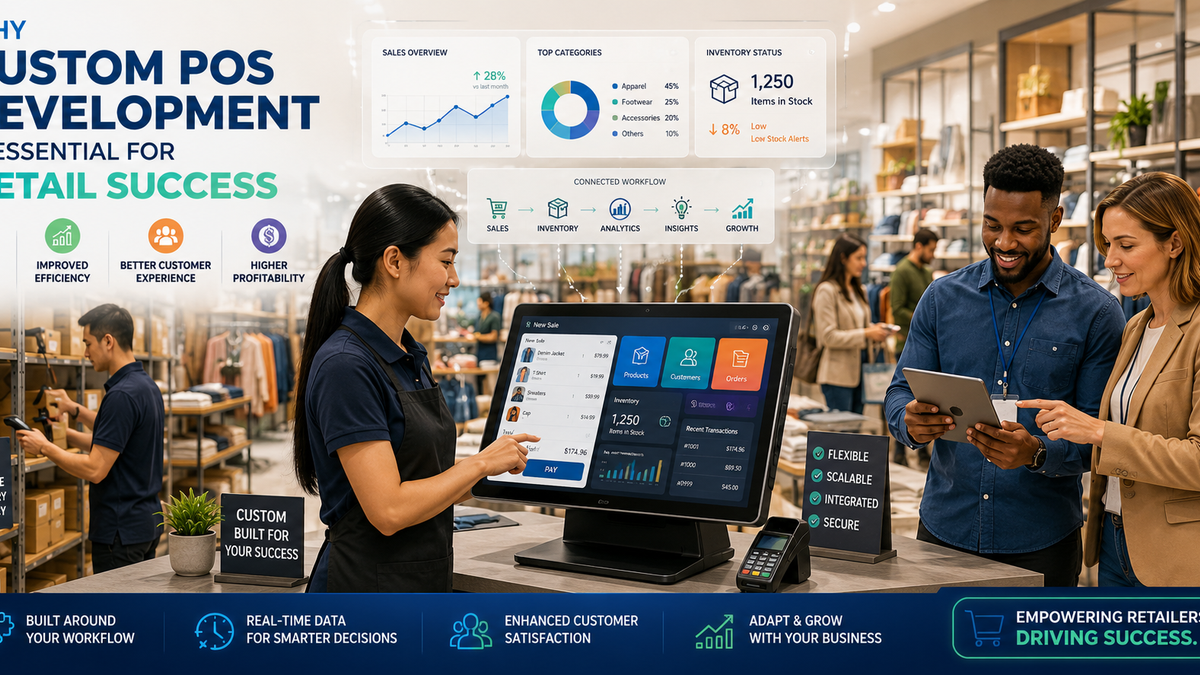
Why Custom POS Development is Essential for Retail Success
Custom POS System Development for Modern Retail Businesses
Building Point of Sale Systems Around Your Business
A point-of-sale system is more than a tool for processing customer transactions. For modern retailers, it can become an important part of daily operations by connecting sales, inventory, customer interactions, reporting, and business workflows.
However, not every business operates the same way. Standard POS platforms may provide many features, but they may not always accommodate the specific processes and operational requirements of a growing organization.
Custom POS system development provides an opportunity to build technology around the business instead of forcing the business to adapt to a rigid system.
GLXY Software Solutions provides custom software solutions designed around the unique requirements of businesses, including retail point-of-sale systems.
GLXY Retail Point of Sale Solutions
Why Businesses Need More Than a Basic POS System
Traditional POS systems typically focus on processing transactions, calculating totals, accepting payments, and generating receipts. Modern retail operations often require much more.
Businesses may need to manage:
- Product and inventory information
- Sales transactions
- Pricing and product variations
- Employee workflows
- Customer information
- Reporting and business insights
- Multiple locations or sales channels
- Business-specific operational processes
When these activities are handled through disconnected systems, employees may have to enter information repeatedly or switch between multiple platforms. This can create unnecessary administrative work and make it harder for managers to maintain an accurate view of business operations.
What Is Custom POS System Development?
Custom POS system development involves creating a point-of-sale solution around the specific requirements of a business.
Instead of providing the same workflow to every organization, a custom solution can be designed around how the business actually operates.
This can include the way employees process transactions, how products are organized, how inventory is managed, and how sales information is reported.
The result is a POS environment that can better support existing processes while providing flexibility for future growth.
Improving Retail Operations Through Better Technology
A well-designed POS system can help connect different parts of a retail operation. A sales transaction can contribute to inventory visibility, reporting, and operational decision-making.
By creating a more connected workflow, businesses can reduce repetitive tasks and give employees better access to the information they need.
Centralized Sales Management
A structured POS system provides a centralized environment for processing and managing sales transactions. This can make it easier for employees to maintain consistent processes while giving management greater visibility into sales activity.
Better Inventory Visibility
Retail businesses need accurate information about products and inventory. A properly designed POS workflow can help connect sales activity with inventory processes and provide a clearer picture of product movement.
More Efficient Employee Workflows
Employees should be able to complete routine transactions without navigating unnecessarily complicated systems. Custom POS development allows workflows to be designed around the needs of the people using the system every day.
Improved Business Reporting
Sales data can provide valuable insight into business performance. A POS system can organize transaction information so businesses can better understand sales activity, product performance, and operational trends.
Designing a POS System Around Your Business
One of the major advantages of custom software development is flexibility. Different businesses may have very different POS requirements.
A custom POS solution can be designed with considerations such as:
- Business-specific transaction workflows
- Product catalog requirements
- Inventory processes
- Employee roles and permissions
- Reporting requirements
- Store-specific procedures
- Integration requirements
- Future scalability
This approach helps ensure that technology supports the business rather than creating additional complexity.
Connecting POS With Broader Business Workflows
A POS system does not have to operate as an isolated application. When properly designed, it can become part of a broader digital workflow that connects sales operations with other business processes.
For retailers, this can help create better visibility across:
- Sales
- Inventory
- Product management
- Reporting
- Customer interactions
- Operational administration
This connected approach can reduce duplicate data entry and help teams work from more consistent information.
The Importance of Scalable POS Technology
Retail businesses change over time. Product catalogs grow, teams expand, locations are added, and customer expectations evolve.
A scalable POS solution can help organizations adapt as they:
- Expand product offerings
- Add employees
- Open additional locations
- Increase transaction volume
- Introduce new workflows
- Require additional reporting
Custom software provides greater flexibility to develop systems with long-term business requirements in mind.
Security and Access Control
POS systems handle important business information, making security an important consideration during development.
Businesses should use appropriate access controls and user permissions so employees have access to the functions and information required for their roles.
A structured approach to access and workflow management can help organizations maintain better control over their systems while supporting efficient day-to-day operations.
Why Custom POS Development Can Be a Better Fit
Off-the-shelf POS systems can be useful for businesses with straightforward requirements. Organizations with specialized workflows may benefit from a more tailored approach.
Custom POS development can provide:
- Greater flexibility
- Business-specific workflows
- Better alignment with operational processes
- Opportunities for integration
- Scalability for future growth
- A more tailored employee experience
Rather than changing the business to fit a predefined platform, custom development allows the technology to be designed around the business.
Building the Right Retail Technology With GLXY Software Solutions
GLXY Software Solutions works with businesses to develop software solutions around their specific operational requirements.
For retail organizations, this includes point-of-sale solutions designed to support the way businesses manage transactions and day-to-day retail workflows.
Explore GLXY's Retail Point of Sale Solutions
The goal is not simply to create another POS interface. It is to build a practical technology solution that can help improve efficiency, organize business processes, and provide a foundation for continued growth.
Conclusion
Point-of-sale technology plays an increasingly important role in modern retail operations. As businesses become more complex, a basic transaction system may not be enough to support every operational requirement.
Custom POS system development provides businesses with the flexibility to create workflows around their specific needs while improving visibility across sales and retail operations.
By working with a custom software development partner such as GLXY Software Solutions, retailers can explore POS solutions designed around their business processes rather than relying entirely on one-size-fits-all technology.
The right POS system should do more than process a sale. It should help the business operate more efficiently.