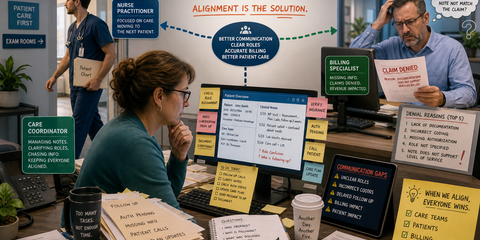
What Changed When Care Notes Started Reaching Billing on Their Own

What Changed When Care Notes Started Reaching Billing on Their Own
The care happened weeks ago. The note existed. Billing still could not use it.
That was the starting point for one care team we worked with. The problem was not that people were doing nothing. It was that each person could finish their part without the next person knowing the work was ready.
This is an anonymized story. We are leaving out the organization, its patients, its contracts, and its private process details. The useful part is the path: find the stuck handoff, make each status mean something, and let finished work move without a person carrying it.
In the last healthcare post, we showed why notes, roles, and billing often describe three different versions of the same visit. This is what changed when those three parts began to agree.
The first problem was not the note
The team already had notes. Some were complete. Some needed a clinician's answer. Some were waiting for a signature. Some belonged to one care program while others followed a different billing rule.
They looked similar in a list, but they did not mean the same thing.
That made billing follow-up a scavenger hunt. A biller had to ask whether the visit happened, find the note, decide whether it was complete, check whether a signature was required, and then ask whether anyone had already sent it.
The note was not missing. Its place in the workflow was missing.
We followed one visit instead of redesigning everything
The first useful conversation was not about features. It was about one visit.
- Who starts the note?
- Who reviews it?
- What question sends it back?
- When does a clinician need to sign?
- What exact status means billing can use it?
Those answers showed the real bottleneck. People were doing the work, but the handoffs lived in memory, messages, and separate lists.
Good AI consulting often makes the first build smaller, not larger. We did not begin by replacing every system around the team. We began with the gap between a finished note and a billing-ready record.
We made the handoffs visible
The shared picture was simple: a note should move through a small number of honest stages.
- In progress: the note is still being written.
- Needs review: a specific person has a specific question to answer.
- Needs signature: the work is complete, but the required clinician has not signed it.
- Ready for billing: every required step is complete and billing can act.
No vague "done" label. No pile where complete and incomplete work look alike. Each status had an owner, an exit condition, and a visible next step.
That shared truth matters more than the screen around it. Business process automation only helps when the system knows what should happen next.
Then we helped the work move
Once the statuses were clear, the system could carry the handoff.
A reviewer could see the notes waiting on them. A clinician could see what needed a signature. Billing could work from a clean queue instead of asking the care team to explain every visit again.
The system could also keep different note types on different paths. A chronic care note should not be held to a nursing-home visit rule, and a note that requires a signature should not move early just because another kind does not.
This is where AI integration and custom AI development can be useful. AI can help organize the record, surface missing context, and prepare a clearer next step. It should not make the clinical decision or quietly mark unfinished work complete. The clinician still decides. The workflow makes that decision visible.
What changed for the care team
The biggest change was not a dramatic new dashboard. It was that people stopped carrying the process in their heads.
- Coordinators could see what was missing without rebuilding the list each morning.
- Clinicians could see which notes needed their decision or signature.
- Billing could see work that was actually ready, not a mix of guesses.
- A new team member could follow the status instead of inheriting a private spreadsheet.
- Leadership could see where work stopped without calling every person involved.
The care did not become automatic. The handoff did.
That distinction matters. Useful healthcare software does not remove people from care. It removes the need for people to copy, chase, and explain work that the system should already understand.
What we did not do
We did not put patient details into a public tool. We did not train a general AI model on private health information. We did not ask software to make a medical judgment.
We also did not claim that one workflow fixed every part of the organization. The first result was narrower: completed documentation had a defined path into review, signature, and billing.
That is enough to change a week. It gives the team one trusted place to start and one clear place to look when work stops.
How to test this in your own operation
Pick five visits that happened last month but have not reached billing. For each one, write down:
- Where the note is now
- Whether it is complete
- Whether it needs review or signature
- Who owns the next step
- What billing is waiting to receive
If the answers live in different systems or different people's heads, that is the project. Start there before buying another broad platform.
cpcReach was built around this path: documentation, review, clarification, consent, and a billing-ready queue for chronic care teams and providers who see patients in nursing homes.
What is next in this series
Next, read the plain buyer's checklist for clinical operations software: what to look for, what questions to ask, and which promises should make you slow down.
If your notes are complete but billing is still waiting, see how cpcReach keeps the handoff visible, or start from our healthcare work and bring one stuck visit to a short call. We will start there.