How Artificial Intelligence Is Transforming Business Operations Through Smarter Automation
The Growing Role of AI in Modern Business
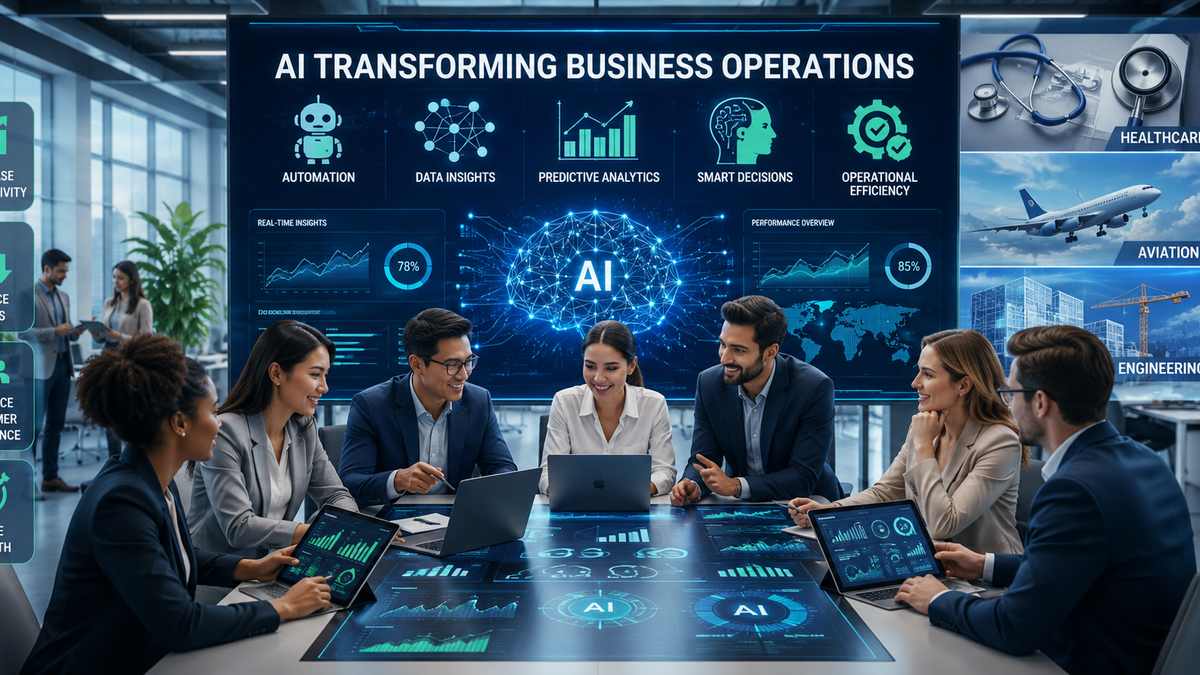
Artificial intelligence (AI) is changing how organizations operate by helping automate repetitive work, improve decision-making, and increase operational efficiency. Rather than replacing people, AI is enabling businesses to work smarter by supporting employees with faster insights, streamlined workflows, and more accurate data processing.
Across industries—including healthcare, aviation, engineering, construction, and manufacturing—organizations are exploring AI to improve productivity while maintaining quality and compliance.
However, successful AI adoption depends on more than implementing new technology. Businesses also need structured software systems, organized data, and well-defined workflows to maximize AI's value.
What Is Artificial Intelligence?
Artificial intelligence refers to computer systems that perform tasks that typically require human intelligence, such as:
- Recognizing patterns in data
- Making recommendations
- Processing documents and information
- Automating repetitive tasks
- Supporting operational decision-making
When integrated into existing business processes, AI can help organizations operate more efficiently while allowing employees to focus on higher-value work.
Why AI Works Best with Structured Business Systems
AI performs best when it has access to accurate, organized, and consistent data.
Many organizations struggle because information is spread across spreadsheets, emails, paper files, or disconnected software platforms. Before AI can deliver meaningful results, businesses often need to improve how information flows throughout the organization.
GLXY Software Solutions develops custom software and workflow solutions that help organizations centralize information, automate business processes, and improve operational visibility.
By creating structured digital workflows, businesses establish the foundation needed to support future AI initiatives.
Practical Ways AI Supports Business Operations
Organizations are applying AI across a wide range of operational functions.
Automating Repetitive Tasks
AI can reduce manual effort by assisting with routine activities such as:
- Document processing
- Data entry
- Information classification
- Workflow routing
- Administrative tasks
Automation allows employees to spend more time on strategic work instead of repetitive processes.
Improving Decision-Making
Modern AI systems can analyze large volumes of operational data and identify trends that might otherwise be overlooked.
This helps managers:
- Monitor operational performance
- Identify workflow bottlenecks
- Allocate resources more effectively
- Improve planning and forecasting
Rather than replacing human judgment, AI provides better information for making informed decisions.
Supporting Document Management
Many businesses manage thousands of documents, making organization and retrieval increasingly difficult.
Solutions like DocuScribe by GLXY Software Solutions help organizations automate document workflows, organize files more efficiently, and improve collaboration across teams.
Learn more:
https://docuscribe.glxysoftwaresolutions.com/
A structured document management system also provides cleaner, more organized data that can support future AI-driven automation.
Improving Industry-Specific Workflows
AI can support operations across many industries.
Healthcare
Healthcare organizations can improve efficiency through:
- Smarter scheduling workflows
- Better document organization
- Improved coordination between departments
GLXY offers healthcare-focused solutions including:
Aviation
Aviation organizations rely on accurate information and coordinated operations.
Structured workflow systems can help improve:
- Operational coordination
- Scheduling processes
- Documentation management
- Team collaboration
Learn more about GLXY's aviation solutions:
https://www.glxysoftwaresolutions.com/aviation
Engineering and Technical Operations
Engineering teams often manage complex documentation and collaborative workflows.
Modern document automation systems help:
- Improve version control
- Organize technical documentation
- Support compliance
- Streamline project collaboration
Considerations Before Implementing AI
Before adopting AI, organizations should evaluate several important factors.
Data Quality
AI depends on accurate and well-organized information. Poor-quality data often produces poor-quality results.
Workflow Readiness
Businesses should first standardize processes before introducing automation.
Security
Organizations must protect sensitive business information through appropriate access controls and cybersecurity practices.
Human Oversight
AI should support employees—not replace responsible human decision-making, especially in regulated industries.
Preparing Your Organization for AI
Businesses don't need to automate everything at once.
A practical approach includes:
- Identify repetitive business processes.
- Digitize and organize operational workflows.
- Centralize business information.
- Implement workflow automation.
- Introduce AI where it provides measurable value.
- Continuously monitor and improve processes.
Organizations that build a strong digital foundation are better positioned to expand their AI capabilities over time.
Looking Ahead
Artificial intelligence will continue to play a larger role in business operations, but successful implementation requires more than adopting new technology.
Organizations need structured workflows, organized information, and scalable software solutions that support long-term growth.
By combining custom software development with workflow optimization, GLXY Software Solutions helps organizations modernize operations and prepare for future AI initiatives. Whether improving document management, streamlining scheduling, or enhancing operational visibility, the right digital foundation enables businesses to take full advantage of AI as it continues to evolve.
In the years ahead, organizations that invest in both intelligent automation and well-designed business systems will be better equipped to improve efficiency, adapt to change, and deliver better outcomes for their teams and customers.