What to Look for in Engineering Document Management

What to Look for in Engineering Document Management
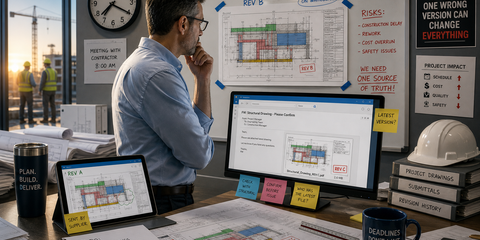
It is 7:20 in the morning and a project engineer is looking at two versions of the same drawing. One is taped to the wall. One is open on the screen. They do not match. Someone in the field is already building from a third copy that arrived as an email attachment.
That person does not want a document management platform. They want to know which drawing is current before the crew pours something they cannot undo.
In the engineering problem post, we named the four places a current set splits: drawing vs approval, document vs reviewer, office copy vs field copy, and project vs long-term record. This checklist is for the next step: choosing engineering document management that people will actually use.
Start with one drawing, not the feature list
Before you sit through a demo, pick one live drawing from an active job. Ask how it moves.
- Who owns the current revision?
- Where does approval live?
- Who is waiting on a review right now?
- What copy is the field working from today?
- Where does this drawing go when the job closes?
If the seller cannot follow that drawing from first mark-up to as-built, the feature list does not matter. Business process automation only helps when the workflow matches the real order of the work.
1. Can you see which revision is current without asking around?
Most engineering teams do not lose files. They lose track of which version counts.
Ask the vendor to show one drawing with revisions C and D. Then ask which one is approved, where that approval lives, and what stops someone from opening the old file by habit. If the answer is a naming convention people are supposed to follow, that is not a system. That is a hope.
Look for one current record. The approved revision should be obvious on the drawing itself, not buried in an email thread.
2. Does a review have an owner and a visible next step?
A submittal sitting in a folder is not waiting. It is lost until someone walks over and asks.
Ask what a reviewer sees when they sign in. Ask how a mark-up gets back to the person who has to act on it. Ask what leadership sees when work is stuck without calling every person involved.
A useful workflow names the owner, the exit condition, and the next step. "In review" with no person attached is the same problem as "done" with no meaning.
3. Does the field get the same current set the office has?
Work gets built off the copy that is easiest to reach. That is almost never the newest file on a network drive.
Ask how a superintendent or inspector gets the current set on a phone or tablet. Ask what happens when a revision is approved at 4 p.m. and the crew is already on site. Ask whether printing, exporting, or sharing creates a new unofficial copy that never comes back.
If the field copy can drift, the office system is a library, not a working set.
4. Does the record survive after the job closes?
The job ends. The drawings, as-builts, certs, and the reason a detail changed scatter across mailboxes and personal drives. Two years later somebody needs to know why a connection changed, and the only copy left with an employee.
Ask where closed-job records live. Ask who can find a drawing without the original project engineer. Ask how you export your own files if you leave the vendor.
Document management that engineers will actually use has to outlast the project and the person who filed it.
5. Can each role see enough without carrying everyone else's job?
The engineer, the reviewer, the field lead, and the project manager do not need the same screen. They do need the same record underneath. That is the same test we used in same problem, different seats.
Ask what each role sees on day one. Then ask whether permissions protect client files without forcing people back into email. If the only way to share a drawing is to download and forward it, the system will lose to the inbox.
6. Will this replace a seam, or add another folder?
The instinct is to buy a tidier place to put things. It usually backfires. Each new repository adds a copy step. Somebody has to upload, rename, and notify. That person becomes the index.
Ask which current tools this system replaces, and which ones stay. Ask what still has to be copied by hand. Honest AI consulting on this usually ends with a smaller first project than people expect: one gap, one drawing type, one team.
Custom AI development on top of scattered folders just produces confident nonsense faster. AI integration, and later AI business solutions around search or change flags, only help after one current record exists.
Questions to bring to the demo
- Show us one drawing from first mark-up through approval and into the field.
- Show us which revision is current, and how we can tell without asking.
- Show a review queue with an owner and a next step.
- Show what the field sees at 7 a.m. after an evening revision.
- Show where this drawing lives two years after the job closes.
- Show each role's screen and what they are not allowed to change.
- Show how we export our records.
- Tell us exactly where AI is used and where a person must decide.
If the demo stays on a dashboard of sample folders and never follows a real drawing, slow down.
Want these on paper? Get the two-page demo scorecard and score each seller as they answer.
The buying decision in one sentence
Choose the system that gives every role one current drawing and one clear next step.
You do not need more folders. You need engineering document management that keeps the approved set, the review, the field copy, and the long-term record in agreement.
We wrote more on this in secure cloud document management for engineers and why engineering teams need better document and project systems. Pulse Point is one way we build around a current set instead of another shelf. If the four-answer exercise from the last post turned up a gap, bring that one drawing and book a short call. We will start there.
What is next in this series
The construction buyer checklist is live: what to look for in construction project software when the office and the field do not yet share one truth. A later engineering proof post will wait until we have a real deal story to tell.