Engineering Teams Don't Need More Folders. They Need One Current Set of Drawings
Engineering Teams Don't Need More Folders. They Need One Current Set of Drawings
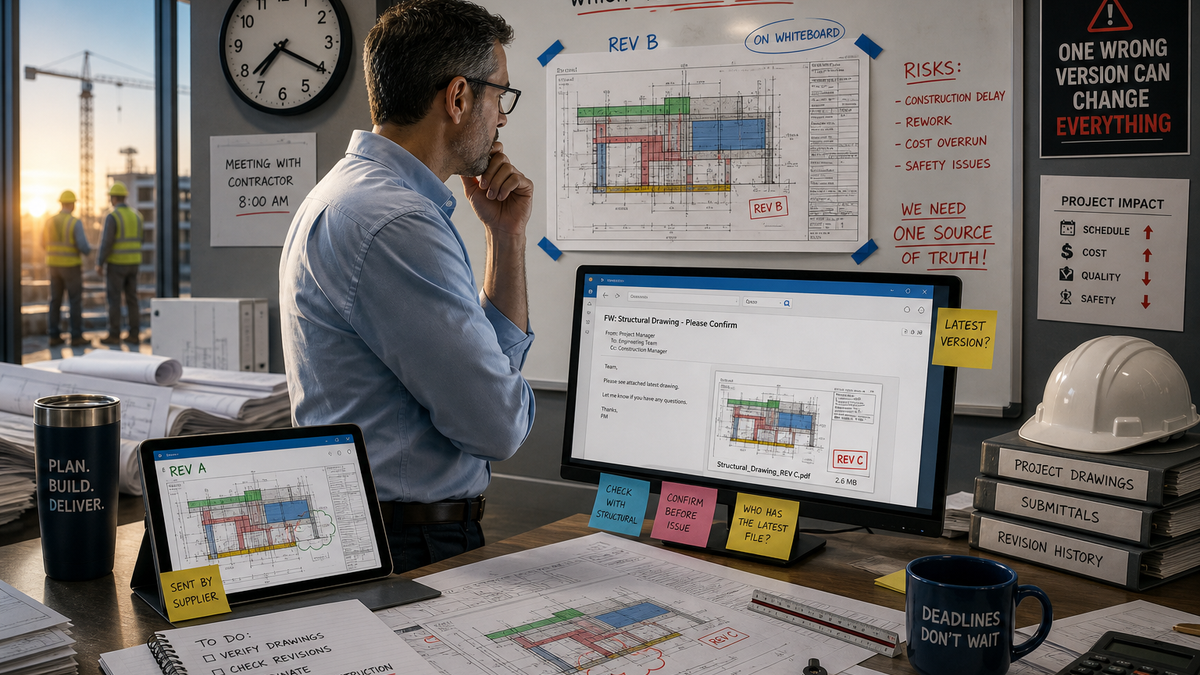
It is 7:20 in the morning and a project engineer is looking at two versions of the same drawing. One is printed and taped to the wall. One is open on the screen. They do not match. Somewhere there is a third copy in an email attachment that somebody in the field is already building from.
Nobody in that room wants a document management platform. They want to know which one is current before the crew pours something they cannot undo.
This is the engineering post in our industry series. We opened the deep dives with shared truth on a construction job and then looked at notes, roles, and billing in healthcare. Engineering has the same split, wearing a different badge.
The problem is not storage
Most engineering teams we talk to are not missing files. They have too many places a file can correctly live.
There is a network drive from the old office. A cloud folder somebody set up for one client. A vendor portal. A folder structure with a naming convention that three people follow and eleven people do not. Every one of those was a reasonable decision on the day it was made.
So when the question comes up, which is current, the honest answer is that a person has to go find out. Ask two engineers which revision is approved and you may get two answers plus a story explaining the gap. That is the same test we used on the job site, and it fails the same way.
The four places the current version splits
With the technical teams we work with, it shows up in the same handful of spots.
Between the drawing and the approval. Revision D got approved Friday. The folder still leads with Revision C, because the approval happened in an email thread and the file did not hear about it. The document is not wrong. It is just not the one that counts.
Between the document and the reviewer. A submittal sits waiting on one person who does not know it is waiting on them. Nobody can see the queue, so status gets tracked by walking over and asking. Chasing reviews becomes a full job that nobody was hired to do.
Between the office copy and the field copy. The current set lives in the system. The set actually being used lives on a tablet, a printout, or an attachment somebody forwarded three weeks ago. Work gets built off the copy that is easiest to reach, which is almost never the newest.
Between the project and the record. The job closes. The drawings, the as-builts, the certs, and the reasoning behind a change scatter across mailboxes and personal drives. Two years later somebody needs to know why a detail changed, and the only copy of that answer left with an employee.
Why buying more storage makes it worse
The instinct is to buy a bigger, tidier place to put things. It usually backfires, because the gap is not a missing shelf. It is a seam between the document and the decision about that document.
Each new repository adds a seam. Somebody has to copy, rename, upload, and notify. That person becomes the index. The company quietly depends on them doing it correctly during their worst week, and on them not quitting.
Plenty of teams reach for business process automation at this point and end up automating the copying instead of removing it. The market is full of AI business solutions promising to read your drawings. Some are genuinely useful. None of them can tell you which revision is approved if the approval never touched the file. Using AI in document review only pays after the record is trustworthy.
Moving to the cloud helps, but only if the pieces share one record. Secure cloud document management for engineers puts everyone in the same building. It does not, by itself, put them on the same page.
What it actually costs
This sounds like a filing problem until you price it.
- Work gets built off a superseded revision, and rework eats the margin you already quoted
- Submittals sit in a queue nobody can see, and the schedule slips a week at a time
- An audit or a client request turns into a three day scavenger hunt
- A new engineer spends their first month learning where things are instead of doing engineering
- Leadership stops trusting the document log and starts calling people directly
That last one is the expensive one. Once nobody believes the system, every decision routes through the two people who remember everything.
What it looks like when the set is current
The fix is less dramatic than a migration. The document carries its own history instead of a person carrying it.
One current version, and the superseded ones clearly marked as superseded rather than deleted. Approval changes the document's status, so the record and the decision cannot drift apart. The review queue is visible, so waiting on somebody is a fact instead of a rumor. The field opens the same record the office does. When the project closes, the reasoning stays attached to the work.
Different roles still need different views. An engineer wants the drawing. A manager wants what is stuck. A client wants the approved set and nothing else. That is the same point we made in same problem, different seats. Same record underneath, different windows on top.
Once that record is clean, the interesting options open up. AI integration finally has something reliable to read. Flagging that a spec changed after a submittal went out becomes part of the workflow instead of a research project. Custom AI development on top of scattered folders just produces confident nonsense faster.
How to find your own split this week
You do not need a vendor demo to run this. Pick one active project and walk it.
- Ask an engineer which revision of one drawing is current.
- Ask whoever approves work whether that revision is the approved one.
- Ask someone in the field which copy they are working from today.
- Ask what is waiting on a review right now, and who owns it.
- Write the four answers on one page and look at where they disagree.
Whatever gap is widest is your first project. Not a platform. One gap. Honest AI consulting on this usually ends with a smaller scope than people expect, and a first useful result in weeks.
What is next in this series
Next in the engineering set: a later proof post will wait on a real deal story. The buyer's checklist is live: what to look for in engineering document management.
If the four-answer exercise turned up a gap you already knew about, see how we think about engineering document and project systems, or take a look at Pulse Point and book a short call. Bring that one drawing. We will start there.