Construction’s Real Problem Isn’t Software: It’s Shared Truth on the Job
Construction’s Real Problem Isn’t Software: It’s Shared Truth on the Job
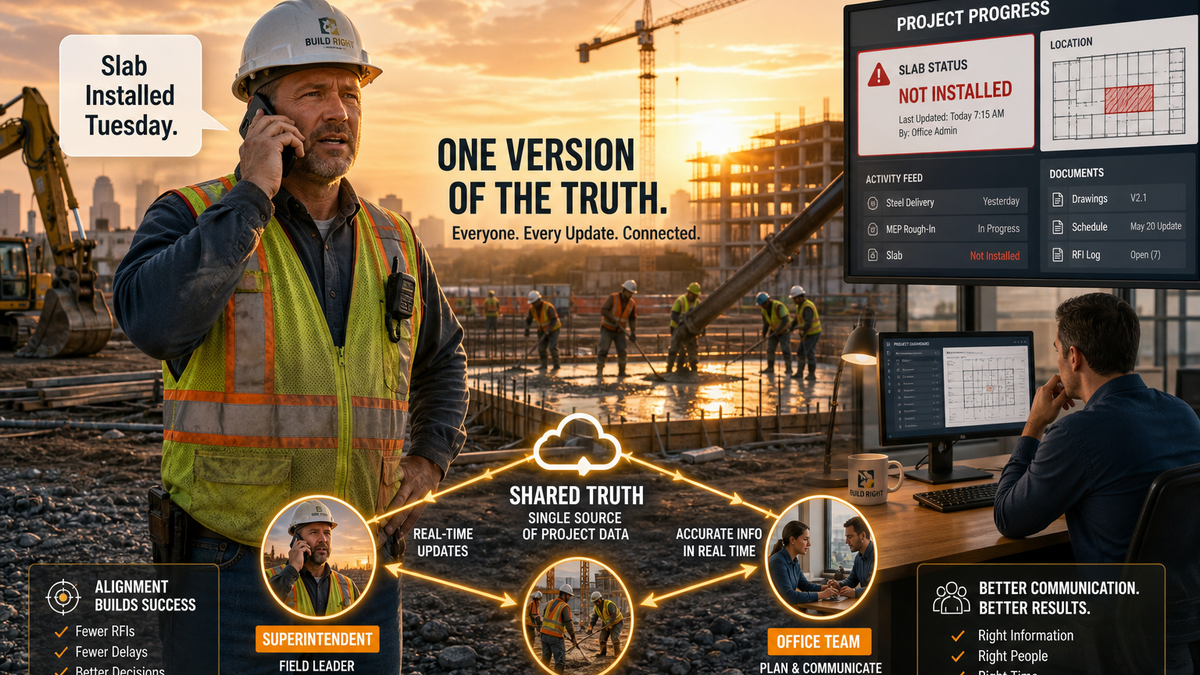
It is 6:40 in the morning and a superintendent is standing in gravel with a phone to his ear. He is telling the office the slab went in Tuesday. The office is looking at a screen that says it did not. Until somebody settles that, the invoice waits, the next crew waits, and the owner hears about it Friday afternoon.
Nobody on that call wants software. They want the two answers to match.
This is the first post in a new series that goes one industry at a time. Series A closed with one ecosystem for many business problems. We start the deep dives with construction, because this is where we hear it loudest.
What shared truth means on a job site
Shared truth is easy to describe and hard to buy. One job number. One set of costs. One status that reads the same in a truck, at a desk, and in a bank meeting.
There is a quick test. Ask two people in two different chairs what a job cost as of this morning. If you get two numbers and a story that explains the gap, you do not have shared truth. You have pieces, and people stitching them together by hand.
That stitching is invisible on a good week. On a bad week it is the reason a bid goes out light.
The four places the truth usually splits
With the builders we work with, the split shows up in the same handful of spots.
Between the quote and the material list. A number goes out to win the job. Then purchasing rebuilds it by hand to actually order material. Now two versions of the same job exist, and only one of them knows this week's pricing. We walked through that exact repair in from first call to working solution.
Between the field and the office. Work happens, gets written on a paper ticket or sent in a text, and reaches the system a day or three later. Every report pulled inside that window is confidently wrong.
Between job cost and accounting. The portal knows what the crew did. Accounting knows what got billed. When cost centers do not line up, jobs quietly stop flowing and somebody discovers it at month end. Keeping those in step is the whole point of tracking project expenses properly.
Between the estimate and the actuals. The estimate sits in one place and the real spend in another, and nobody lines them up until the margin is already spent.
Why buying more construction software makes it worse
The instinct is to buy something for the gap. It usually backfires, because the gap is not a missing feature. It is a seam between two systems that were never told about each other.
Each new tool adds a seam. Someone has to export, retype, reconcile, and forward. That person becomes the integration, and the company quietly depends on them doing it correctly during their worst week. Plenty of teams reach for business process automation at this point and end up automating the copying instead of removing it.
The market is full of AI business solutions aimed at builders. Some of them are good. None of them can reconcile two systems that disagree about what a job cost.
The cloud helps, but only if the pieces share a record. Moving construction project management to the cloud puts everyone in the same building. It does not, by itself, put them on the same page.
What it actually costs
Shared truth sounds like a tidy-office problem until you price it.
- Bids priced off last quarter's material costs
- Change orders that never get billed because nobody wrote them down in the system
- Margin problems found in week nine instead of week two
- A superintendent doing data entry at 7pm instead of planning tomorrow
- Owners who stop trusting the reports and start calling people directly
That last one is the expensive one. Once leadership stops believing the numbers, every decision slows down and gets made on gut feel.
What it looks like when the truth is shared
The fix is less dramatic than a rebuild. The job carries its own history instead of a person carrying it.
A quote number follows the work from first draft through materials, costing, and storage, so anyone can trace what was promised. The field updates a status once and the office sees it, not a retyped copy of it. Purchasing sees current pricing. Sales sees a simple screen. Accounting sees the depth it needs. Same record underneath, different views on top, which is the point we made in same problem, different seats.
Once that record exists and stays clean, the interesting options open up. AI integration finally has something real to read. Flagging a margin sliding under thirty percent before it lands becomes a normal part of the workflow instead of a science project. AI and machine learning in construction only earns its keep after this step. Custom AI development on top of disagreeing data just produces confident nonsense faster.
How to find your own split this week
You do not need help to run this. Pick one active job and walk it.
- Ask the estimator what the job was quoted at.
- Ask purchasing what has been ordered against it.
- Ask the superintendent what got done as of this morning.
- Ask accounting what has been billed.
- Write the four answers on one page and look at where they disagree.
Whatever gap is widest is your first project. Not a platform. One gap. Honest AI consulting on this usually ends with a smaller scope than people expect, and a first useful result in weeks.
What is next in this series
The construction buyer checklist is live: what to look for in construction project software. A later proof post will wait until we have a real deal story to tell. Next up, the series moves to healthcare, where the same split shows up as notes, roles, and billing that do not agree.
If the four-answer exercise turned up a gap you already knew about, see how we think about construction operations, or book a short call and bring that one job. We will start there.