One Ecosystem for Many Business Problems

One Ecosystem for Many Business Problems
You bought something to fix the quoting. It helped. Then the job cost report was still late, so you bought something for that. Now there are two systems, they do not agree, and someone spends Monday morning deciding which one to believe.
That is how a company ends up with eight tools and the same stuck week it started with.
This is the last post in the series. We began with the problems leaders keep bringing us, then covered what AI actually does for a business, how we listen before we build, the path from a first call to a working solution, and how one problem looks different from every seat. Here is the part that ties them together.
A quick recap of the problems we named
Across every call, the same short list keeps showing up:
- Quotes that have to be fast, accurate, and familiar, or deals stall
- Job cost and margins that show up too late to change anything
- Field and office looking at numbers that do not match
- Care teams needing roles, clean notes, and a billing queue that holds
- Hard-won answers trapped in phone calls nobody can search
Notice what none of those are. None of them is a request for software. Each one is a place where work stops moving.
Why point fixes keep failing
A point tool is built to solve one slice. That is why it demos so well. The trouble starts at the edges.
The quoting tool does not know your real material costs. The accounting system does not know what the field did yesterday. So a person becomes the integration. They export, retype, reconcile, and forward. That person is now the most fragile part of your operation, and nobody planned it that way.
Every new tool adds another seam. Three tools have three seams. Six tools have far more than six, because they all touch each other. The tools get better and the week gets worse.
Buying more business process automation at this stage usually speeds up the copying rather than removing it.
What ecosystem means in plain terms
We do not mean one giant program that does everything. That is the other trap, and it takes two years to find out it does not fit.
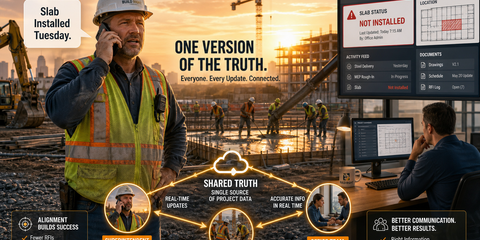
An ecosystem means the pieces are built to share one truth. A job is a job everywhere. A quote number follows the work from first draft through materials, costing, and storage. When the field updates something, the office already knows. Each role gets the view it needs, at the depth it needs, pulling from the same record.
Some parts you build. Some parts you keep, because a system your team already trusts is worth working around. The job is the connective tissue, not the logos. That is where AI integration and, when the pattern is real and repeated, custom AI development actually pay off. There is finally clean, connected data for them to work on.
How construction, engineering, and ops problems connect
These look like different industries and behave like the same problem.
A builder needs a quote that turns into a material list without retyping. An engineering team needs a document that stays findable and current after the project moves on. A care team needs a note that reaches billing without a phone call. An operations group needs to know what happened in the field before the month closes.
Every one of them is the same question. Does the work carry its own history, or does a person have to carry it? Answer that once, in the shape of your business, and it holds across departments.
How to tell whether a partner fits
If you are evaluating help, these questions separate the useful from the impressive:
- Do they ask about your worst week before they show you a screen?
- Can they explain the plan without jargon to someone who will use it daily?
- Will they show a mock-up before writing the real thing?
- Are they willing to keep a system you already have, or does everything have to be replaced?
- Can they name what they will not build, and why?
- Does the first useful result arrive in weeks, not next year?
- Do they say plainly when a problem does not need AI?
Honest AI consulting sometimes ends with a smaller project than you expected. That is a good sign, not a lost sale.
Where this series goes next
Series A stayed deliberately cross-industry. Next we go deeper into single verticals: construction and shared truth on the job, engineering documents and workflow, and aviation operations. Same approach, more specific.
If you want a head start, read why cloud-based platforms help modern businesses and how automated systems and workflow solutions change the day-to-day.
Where to start
You do not fix everything at once. You start with the bottleneck that costs the most this month, solve it in a way that shares its data, and let the next piece connect to it.
That is the whole method. Name the problem, listen, mock it up, build what people will open, and make sure the next problem gets easier instead of harder.
If you want to map your problems to one path, see how we think about construction operations, or book a short call and bring the bottleneck that ate last week. We will start there.